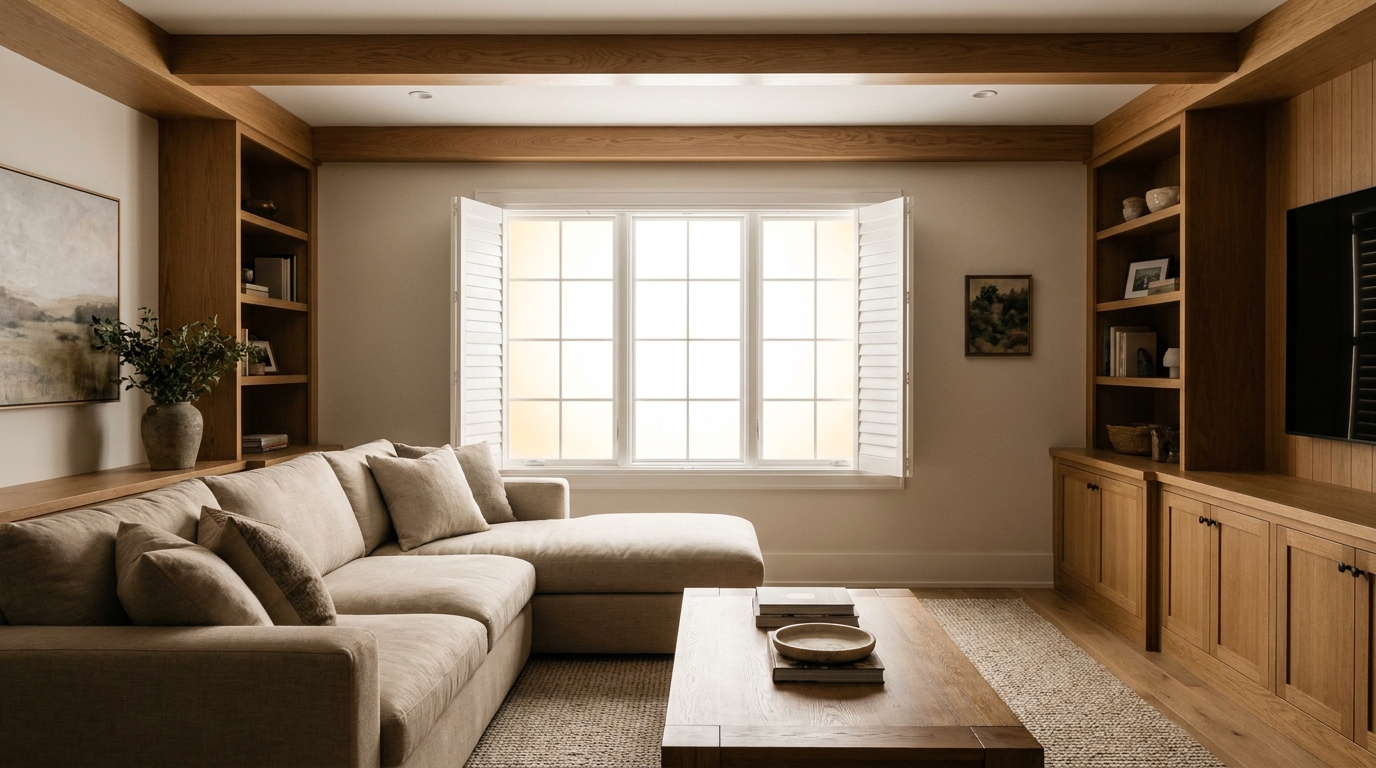
Most finished basements fail for the same reason. The flooring is right, the millwork is right, the furniture is right — and the room still feels like a basement. What's missing isn't square footage or ceiling height. It's daylight. A basement faux window solves that problem directly: it's a custom LED panel built into the wall, framed and trimmed like a real window, that produces the same soft, even, daylight-colored illumination you'd get from a south-facing opening on an overcast morning.
This guide covers how the technology actually works, where it makes sense, and what to look for when specifying a unit for a real project.
What a Faux Window Actually Is
Strip away the framing and a faux window is an edge-lit or back-lit LED panel behind a diffusing face. The LEDs sit around the perimeter or in bars across the back of an aluminum housing; the light travels through an optical layer that scatters it evenly across the full surface. What you see from the room is a flat, uniform plane of light with no visible dots, no hot spots, and no dark corners — which is exactly what real daylight through a window looks like from inside.
The framing on top of that is what sells the illusion. A faux window with shutters, a proper sill, and correctly proportioned trim reads as architecture. The same panel surface-mounted to drywall with no casing reads as a light fixture. That difference is worth planning for before anything gets built.
Color temperature matters just as much. Daylight sits roughly in the 5000K–6500K range, but a basement family room lit entirely at 6500K feels clinical rather than sunny. Most residential installations land warmer, and because every Prime Light Boxes unit is dimmable — compatible with standard wall dimmers or remote-controlled dimmers — you can dial the intensity down in the evening so the room follows a natural daily rhythm instead of blasting noon-level light at 10pm.
Where a Basement Faux Window Belongs
Basement family rooms and rec rooms. The most common application, and the one with the biggest payoff. A single well-placed faux window on the longest uninterrupted wall does more for perceived room quality than any amount of recessed lighting.
Basement bedrooms and guest suites. Windowless sleeping spaces feel oppressive. A faux window on a dimmer, wound down at night and brought up in the morning, makes the room usable for guests who'd otherwise refuse to sleep down there.
Home offices and gyms. Both are rooms where people spend long stretches, and both benefit disproportionately from a sense of exterior connection. A faux window opposite a desk changes how a workday feels.
Interior commercial rooms. Windowless conference rooms, treatment rooms, salon stations, restaurant banquettes along an interior wall, and hotel corridors all use the same principle. In commercial settings the unit often runs larger and the framing gets simpler.
Stairwells and landings. Basement stairs are usually the darkest transition in a house. A narrow vertical faux window on the stair wall handles that in one move.
Sizing and Placement
There are no standard sizes here — every unit is manufactured to the exact dimensions of your opening, with a minimum order of one. That's a practical advantage, because a faux window that matches the proportions of the real windows elsewhere in the house is far more convincing than one sized to whatever an off-the-shelf catalog happened to offer.
A few placement rules that hold up in practice:
- Mount at real window height. Sill at roughly 30"–36" above finished floor for a standard casement proportion. A faux window mounted too high reads as a skylight or a sign; too low and it reads as a floor lamp.
- Put it where a window would plausibly go. An exterior-facing wall is the intuitive choice even in a basement, because that's where the eye expects daylight to originate.
- Avoid direct sightlines from the seating position. You want the light washing the room, not staring back at you. Offset from the primary seating axis where possible.
- Go bigger than feels necessary. The single most common regret is undersizing. A 24"×36" panel in a 400 sq ft room is a nightlight. Two larger units, or one wide multi-pane unit, carry a room properly.
For rooms where you want the daylight effect without a literal window — a wine cellar, a long hallway, a feature wall — a backlit light panel with no framing may be the better call. The illumination technology is the same; only the presentation changes.
What to Look For in a Unit
Not all illuminated panels are built to the same standard, and the differences show up years later rather than on day one.
Even illumination across the full face. This is the single hardest thing to engineer and the easiest place to cut corners. Ask to see a photo of an installed unit at full brightness, not a rendering. Hot spots and banding are permanent.
CSA/UL certification. Anything wired into a residential or commercial wall needs to meet North American electrical safety standards. Every Prime Light Boxes product is CSA/UL certified — no exceptions, no "certification pending."
A properly sized power supply, included. Every unit ships with a UL/ETL-approved power supply sized with 20% extra headroom, so the driver isn't running at its limit for the life of the fixture. A supplier who sells the panel and leaves you to source a driver is handing you a failure point.
LED life and warranty. LEDs rated for 50,000+ hours and a 3-year warranty on the complete unit. At four hours a day, 50,000 hours is more than three decades of service.
Who actually built it. Prime Light Boxes designs and manufactures every product in-house at the Richmond Hill, Ontario facility — not assembled from imported parts, not white-labeled. That matters when you need a non-standard dimension, a specific trim detail, or a straight answer about lead time. Most orders ship in 1–2 weeks, with smaller units possible in as little as two days and rush service available on request. Shipping is free within Canada and ships duty-free and tax-exempt to the US under CUSMA.
Installation Realities
A faux window is a permanent-grade fixture, and it should be planned into the build the way you'd plan a real window: rough opening framed, low-voltage wiring pulled to the location, and the driver placed somewhere accessible but out of sight. Retrofitting into a finished wall is entirely doable — it's a drywall cut and a wire pull — but it's cheaper and cleaner if the wall is still open.
Two details worth deciding early:
- Where the driver lives. Behind an access panel, in an adjacent closet, or in a mechanical room. It's small, but you want to be able to reach it.
- How it's switched. A dedicated dimmer at the room entry treats the faux window as architectural lighting rather than as a lamp, which is the right mental model.
The Practical Case
A finished basement typically returns a fraction of what the same square footage returns upstairs, and the reason people give is almost always some version of "it feels like a basement." Daylight is the variable that changes that judgment. A faux window is the only way to introduce it into a room that has no exterior wall to open.
Built to the right size, mounted at the right height, and dimmed to match the time of day, it stops being a lighting product and becomes part of the room.
Prime Light Boxes builds every faux window to your exact dimensions at our Richmond Hill, Ontario facility. Browse the full range at primelightboxes.com or call 416.269.0447 to talk through a project.