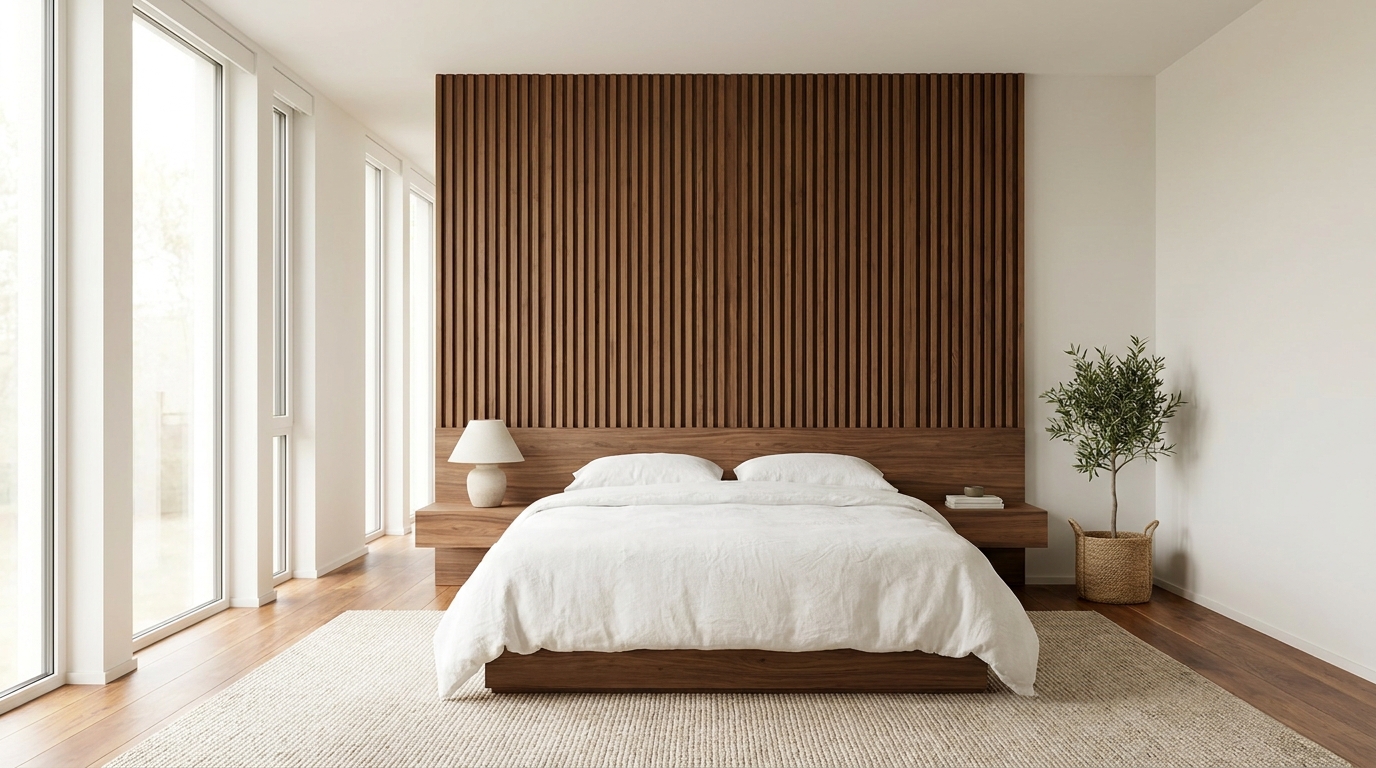
A wood slat accent wall has become one of the most requested features in living rooms, primary bedrooms, and home offices this year — and for good reason. It brings texture, warmth, and a sense of craftsmanship to a flat wall without the cost or disruption of a full renovation. Unlike wallpaper or paint, a wood slat accent wall reads as a genuine architectural upgrade, and it uses the same permanent paneling system homeowners already choose for room dividers.
If you've been picturing wood slats only as a way to split an open floor plan, it's worth knowing the same SKANDINAVIA panels mount flush against a single wall just as easily, turning it into a feature wall that anchors the whole room.
Why a Wood Slat Accent Wall Works
Open-plan homes and builder-grade primary bedrooms often share the same problem: a large, uninterrupted wall with nothing to give it scale or warmth. Paint alone rarely solves this. A wood slat accent wall adds dimension through repetition and shadow — each slat catches light differently throughout the day, which is something a flat painted surface simply can't do.
This is also why the look pairs so naturally with Scandinavian, Japandi, and mid-century modern interiors, all of which lean on real materials and clean repeating lines rather than ornamentation. A slat wall behind a bed, a sofa, or a home office desk becomes the visual anchor for the whole room, and everything else — furniture, lighting, rugs — gets styled around it.
Where It Makes the Most Impact
- Behind a bed: replaces a traditional headboard wall with floor-to-ceiling texture, no bulky furniture required.
- Behind a media console or sofa: gives a living room a designed focal point instead of a bare wall.
- Home office feature wall: adds warmth to a space that's otherwise dominated by a desk and screens, and reads well on video calls.
- Entryway or stair landing: a narrower wall segment is often enough to make a strong first impression as soon as someone walks in.
Choosing a Finish for a Single Wall
Because an accent wall is a smaller footprint than a full room divider, it's a good place to experiment with a bolder finish than you might choose for a larger installation. Primo Panels' SKANDINAVIA line comes in five standard finishes: Walnut and Dark Walnut for a rich, saturated look; White Oak for a lighter Scandinavian feel; an unfinished/stainable veneer for anyone who wants to match an existing wood tone in the room; and a paintable MDF option for a fully custom color.
A general rule that works well for accent walls: if the rest of the room is light and neutral, Dark Walnut or Walnut creates contrast and becomes the room's focal point. If the room already has warm wood tones — flooring, furniture, trim — White Oak or an unfinished veneer stained to match keeps the look cohesive rather than competing with what's already there.
Slat Spacing and Cross-Section
Slat spacing changes the character of the wall more than most people expect. Tighter gaps between slats create a denser, more formal look and read almost like a solid paneled wall from a distance. Wider gaps feel more casual and let more of the painted wall behind show through as a secondary tone. Cross-section width matters too — Primo Panels offers 2"×4" as the standard profile, with 2"×5" and 2"×6" options for a bolder, more substantial look on larger walls. For an accent wall under 10 feet wide, the standard 2"×4" profile is usually enough to make a strong statement without visually shrinking the room.
The Build and Price tool at primopanels.com lets you enter your exact wall width and height, choose a finish and cross-section, and get a precise slat count and price before ordering — which matters more on an accent wall than a large divider, since even a few inches of miscalculation is more noticeable on a single feature wall.
Installation Is Still Permanent — By Design
It's worth being direct about this: a wood slat accent wall from Primo Panels is a permanent architectural feature, not a peel-and-stick or adhesive product. Slats are professionally installed and secured to the wall structure, the same way any other wall paneling would be. That permanence is exactly what gives the finished wall its weight and quality — it looks and feels like it was built into the room, not added on top of it. Homeowners investing in an accent wall are typically also planning to stay in the space for years, which is part of why the finish and layout decisions above are worth taking seriously up front rather than treating the project as something temporary or easily swapped out.
For sloped ceilings, staircases, or walls with obstructions like outlets or vents, custom brackets and cut-to-length slats can accommodate the layout — the same custom fabrication Primo Panels already offers for room dividers applies here.
Bringing It Together
A wood slat accent wall is one of the simplest ways to bring real material warmth into a room without a full renovation, and it uses the exact same premium veneer or paintable MDF panels as Primo Panels' room dividers — just applied to a single wall instead of splitting a floor plan. Start by identifying which wall in your home gets the least visual interest today, then work backward from finish, spacing, and cross-section to land on a design that suits the room around it.
Explore finishes and use the Build and Price tool at primopanels.com to get an exact quote for your wall dimensions.